
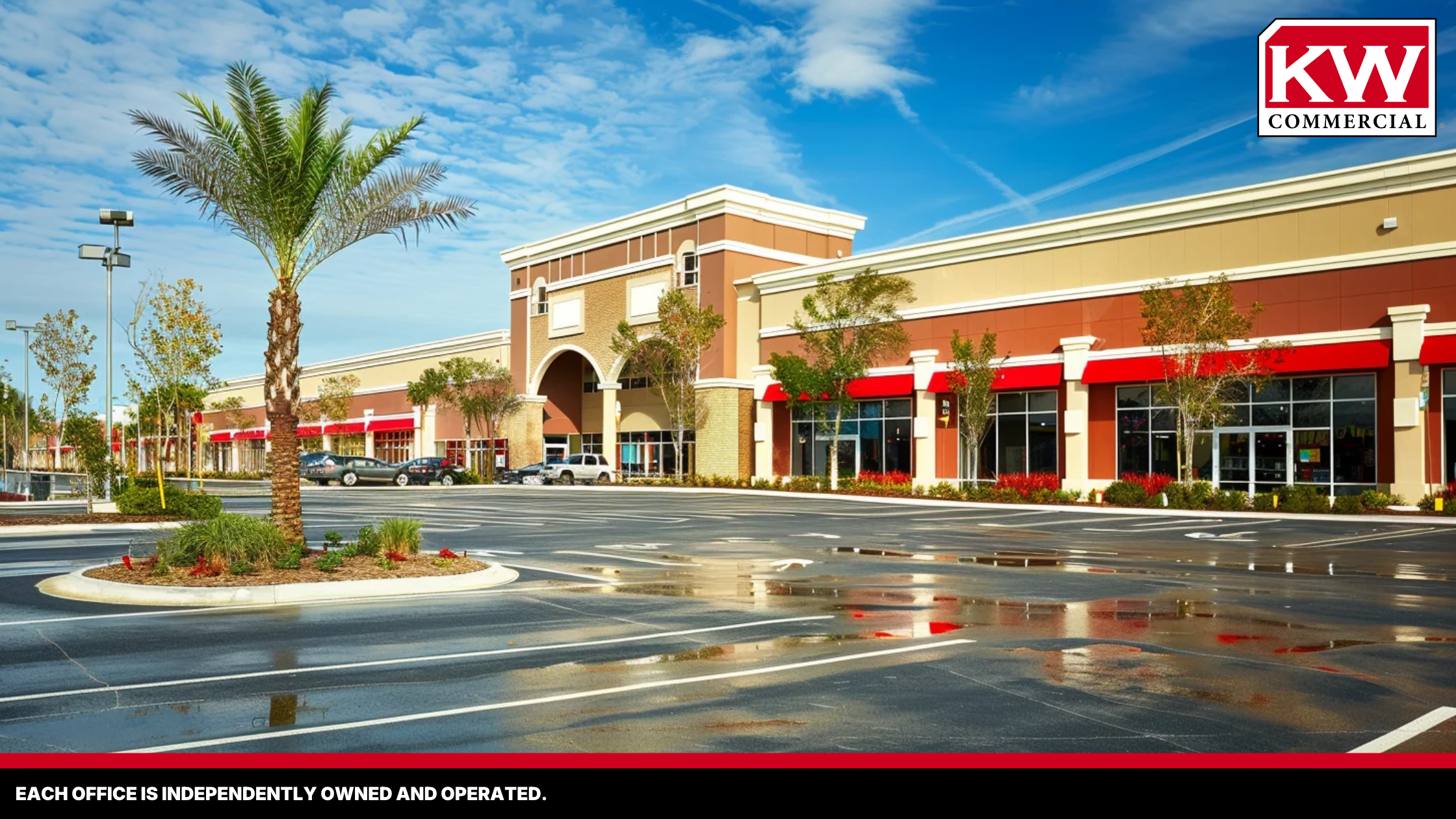
A busy parking lot can make a shopping center look successful.
But a busy afternoon does not necessarily tell us whether customers will return tomorrow, next week, or next month.
That distinction is becoming increasingly important across Houston's retail landscape.
As commercial real estate enters the final months of 2026, the most useful retail question is not simply how much traffic a property attracts.
It is what gives customers a reason to return—and whether that demand fits the surrounding trade area.
Houston retail remains tight, but the numbers tell a more selective story
The broad market is holding up well.
According to Cushman & Wakefield's Q3 2026 Houston Retail MarketBeat, retail vacancy finished the quarter at 5.7%, while net absorption reached approximately 444,000 square feet.
Average asking rents increased to $22.05 per square foot, representing an 8.2% increase from a year earlier.
But leasing activity told a more cautious story.
Through the first nine months of 2026, retail leasing volume was approximately 22% lower than during the same period in 2025.
Those numbers are not contradictory.
They show a market where limited availability can support pricing even as retailers become more selective about expansion.
For owners and investors, that creates an important distinction.
A tight retail market does not make every location equally competitive.
The real asset is the customer's routine
Retail demand is shaped by how people live.
Where they shop for groceries.
Where they take their children.
Where they see healthcare providers.
Where they eat during the workweek.
Where they go for fitness, personal care, and recurring services.
A shopping center that fits naturally into those routines has a different competitive advantage from one that depends primarily on occasional discretionary visits.
Grocery is a particularly useful example.
A grocery store can establish a regular reason to visit a location. Surrounding tenants may benefit when customers can conveniently combine that trip with dining, pharmacy needs, personal services, or another errand.
Medical and wellness users can add another layer of purpose-driven visits.
Restaurants and cafés can activate different times of day.
Fitness and personal-service concepts can generate recurring appointments.
The value is not simply that these categories exist next to one another.
It is whether they work together in a way that makes the center more useful.
And that is highly dependent on the trade area.
Houston's growing suburbs create opportunity—but not automatically
Houston's population growth is an important part of the retail conversation.
The U.S. Census Bureau's 2025 population estimates, released in 2026, show that the Houston-Pasadena-The Woodlands metropolitan area added approximately 126,720 residents between July 2024 and July 2025.
Harris County gained nearly 48,700 residents, while Montgomery County added approximately 30,000 and Fort Bend County gained more than 24,000.
That growth expands the potential consumer base.
But rooftops do not automatically translate into strong retail performance.
A property must still capture demand.
That requires the right road access, competitive positioning, tenant mix, visibility, and customer convenience.
The formula in a growing Cypress community may differ significantly from the formula in an established Inner Loop retail corridor.
In a newer suburban trade area, residents may be looking for convenient alternatives to longer trips for everyday needs.
In an established corridor, the challenge may be securing a location that remains relevant amid more intense competition, higher occupancy costs, and changing consumer routines.
The market opportunity is real.
But the winning strategy is local.
Cypress offers a useful development example
One recent Houston-area project illustrates the importance of thinking about retail as a collection of complementary uses.
In September 2026, Trademark Property Company and MetLife Investment Management announced financing and plans for Dunham Pointe, a 202,000-square-foot retail and restaurant district at Highway 290 and Mason Road in Cypress.
The planned development is anchored by Whole Foods Market and had 14 tenants signed at the time of the announcement, including restaurants, retail concepts, and service-oriented businesses.
The project is designed around a growing residential community and a mixture of shopping, dining, and service uses.
That makes it a useful example of how developers are approaching the trade-area opportunity.
But the distinction matters: a planned or preleased center is not proof of future customer traffic or investment performance.
Those outcomes depend on successful delivery, tenant operations, customer behavior, and the surrounding competitive landscape.
The project's significance is its intended commercial positioning.
It seeks to give surrounding residents several reasons to use the same destination.
Grocery is an anchor—but the supporting cast matters
A strong anchor can attract customers.
The surrounding tenant mix determines whether the center offers more reasons to return.
Consider two shopping centers with similar grocery anchors.
One has complementary medical services, personal care, convenient food, fitness, and practical everyday retailers.
The other has a collection of unrelated concepts with overlapping operational problems or little connection to the customer base.
Both may have good visibility.
Both may have strong traffic counts.
But their ability to support repeat visits, cross-shopping, and long-term tenant relevance may differ.
That is why the tenant mix must be treated as a strategy rather than a collection of available leases.
The right categories should match the neighborhood's needs.
And the site must support how those customers actually use the property.
A medical tenant that generates appointments may not create much benefit for nearby retailers if access is difficult, parking is inadequate, or customers leave immediately after the visit.
A restaurant may draw customers but create operational conflicts if drive-through queues interfere with neighboring storefronts.
Complementarity is not automatic.
It must work in practice.
The national retail trend supports the same direction
This local approach aligns with the broader retail outlook.
In its 2026 U.S. Retail Market Outlook Midyear Review, CBRE identified grocery, discount, off-price, service retail, and fast-casual or quick-service food as important sources of continued leasing activity.
The firm also emphasized that retailers are increasingly selective about site quality and newer space.
That does not mean discretionary retail has disappeared or that every necessity-based tenant is automatically successful.
It means the operating logic behind a location is receiving greater scrutiny.
For owners, the question becomes less about filling the last available suite and more about selecting a tenant whose demand is well suited to the center.
The owner perspective: lease for relevance
In a relatively tight market, it can be tempting to prioritize the highest proposed rent.
But a high starting rent does not necessarily create the best long-term outcome.
Owners should also consider how a tenant contributes to the center's customer activity, lease durability, operating compatibility, and future leasing appeal.
That means evaluating:
Which tenants create recurring visits.
Whether their customer profiles complement one another.
How parking and access work during peak hours.
Whether backfills strengthen or weaken the overall mix.
Which tenants are approaching renewal.
Whether current rents are sustainable for the businesses occupying the space.
A well-considered backfill can improve more than one vacant storefront.
It can strengthen the center's competitive position.
The investor perspective: understand the demand beneath the rent roll
For retail investors, occupancy remains important.
But tenant quality and demand durability matter just as much.
A shopping center can report healthy occupancy while facing future challenges from lease expirations, tenant concentration, competition, or increasing operating costs.
The more useful underwriting questions include:
Is the tenant mix consistent with the surrounding trade area?
Are customers likely to have recurring reasons to visit?
Is nearby residential growth already reflected in leasing assumptions?
Are new competing centers under development?
Do asking rents translate into achievable effective rents?
How much capital will be required to maintain the center's relevance?
And are lease renewals supporting the income story?
Actual customer visitation patterns, tenant sales, and renewal performance—where reliably available—can help test a repeat-trip thesis. Market vacancy statistics alone cannot prove how often customers return.
The next 90 days: what to watch
As Houston moves toward 2027, several signals deserve attention.
Tenant expansions: Which grocery, medical, food, and service categories are actively seeking Houston locations?
Strategic backfills: Which types of businesses are replacing vacancies in established centers?
Renewals: Are recurring-service and necessity-based tenants extending their commitments?
New development: Are suburban projects delivering with meaningful preleasing, or creating additional competition?
Effective rent: Are landlords achieving stronger economics after incentives and tenant-improvement costs?
Trade-area demand: Are observed customer patterns supporting the original leasing assumptions?
Houston retail continues to offer compelling opportunities.
But the strongest conclusions will not come from vacancy rates alone.
They will come from understanding the customers, the surrounding neighborhoods, and the tenants that give people reasons to keep returning.
In Houston retail, routine may be the most important anchor of all.